Creating a consistent client experience across 150 programs
Barrington partnered with an organization to identify opportunities to improve and standardize service delivery, creating a clear path toward a more consistent and scalable client experience.

Client
Non-profit Service Delivery Organization
Services
Operations and Lean Six Sigma
Industry
Non-profit
The challenge
A large service delivery organization was looking to improve how clients moved through its services and programs. With multiple service areas supporting a diverse client base, delivering a consistent experience across the organization was becoming increasingly complex.
As the organization grew, processes evolved independently across programs, creating inconsistencies in how clients were received, assessed, referred, and supported. This resulted in varying client experiences across programs and created inefficiencies for staff working across the organization.
With a new customer relationship management (CRM) tool on the horizon, the organization recognized an important opportunity: optimize the way work happens before digitizing it.
The solution
Barrington partnered with the organization to identify opportunities to improve and standardize service delivery, creating a clear path toward a more consistent and scalable client experience.
Using Lean Six Sigma principles, process-flow analysis, and collaborative problem-solving, we worked directly with frontline staff to understand how they delivered services, identify the root causes behind recurring challenges, and co-design a future state that supports both improved service delivery and CRM modernization.
Here’s what we did:
- Mapped the end-to-end client journey across all eight departments. We worked with staff to document the current state and identify where processes, handoffs, and practices varied across programs.
- Brought client and staff perspectives into the analysis. We developed surveys for employees, as well as current and former clients, allowing us to compare the documented processes with the lived experience of those delivering and receiving services
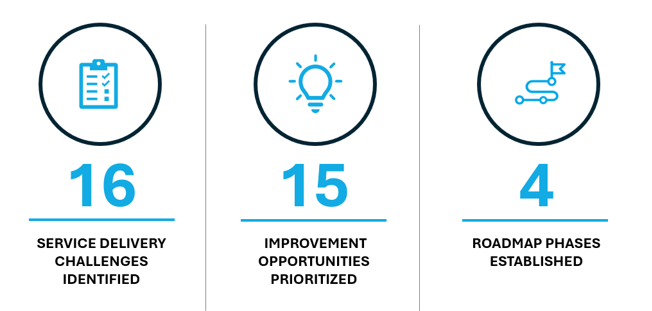
- Traced 16 challenges back to five systemic root causes. Rather than addressing individual pain points in isolation, we identified the underlying issues creating challenges at multiple points in the client journey.
- Developed and prioritized 15 operational excellence recommendations. Each opportunity was linked to the root causes it addressed, then evaluated based on its anticipated benefits and ease of implementation.
- Turned recommendations into an actionable four-phase roadmap. We sequenced initiatives based on priority and dependencies, giving the organization a clear path to implement improvements in a logical and manageable way.
The results
The organization now has a clear and actionable path to improve service delivery before implementing new technology.
By identifying 16 service delivery challenges, tracing them to five systemic root causes, and prioritizing 15 improvement initiatives, the organization gained a shared understanding of where change is needed and how to achieve it.
A four-phase implementation roadmap provides a practical path toward more consistent, integrated, and client-centered services.